Piano worlds collide, converge with Rana at Carnegie Hall
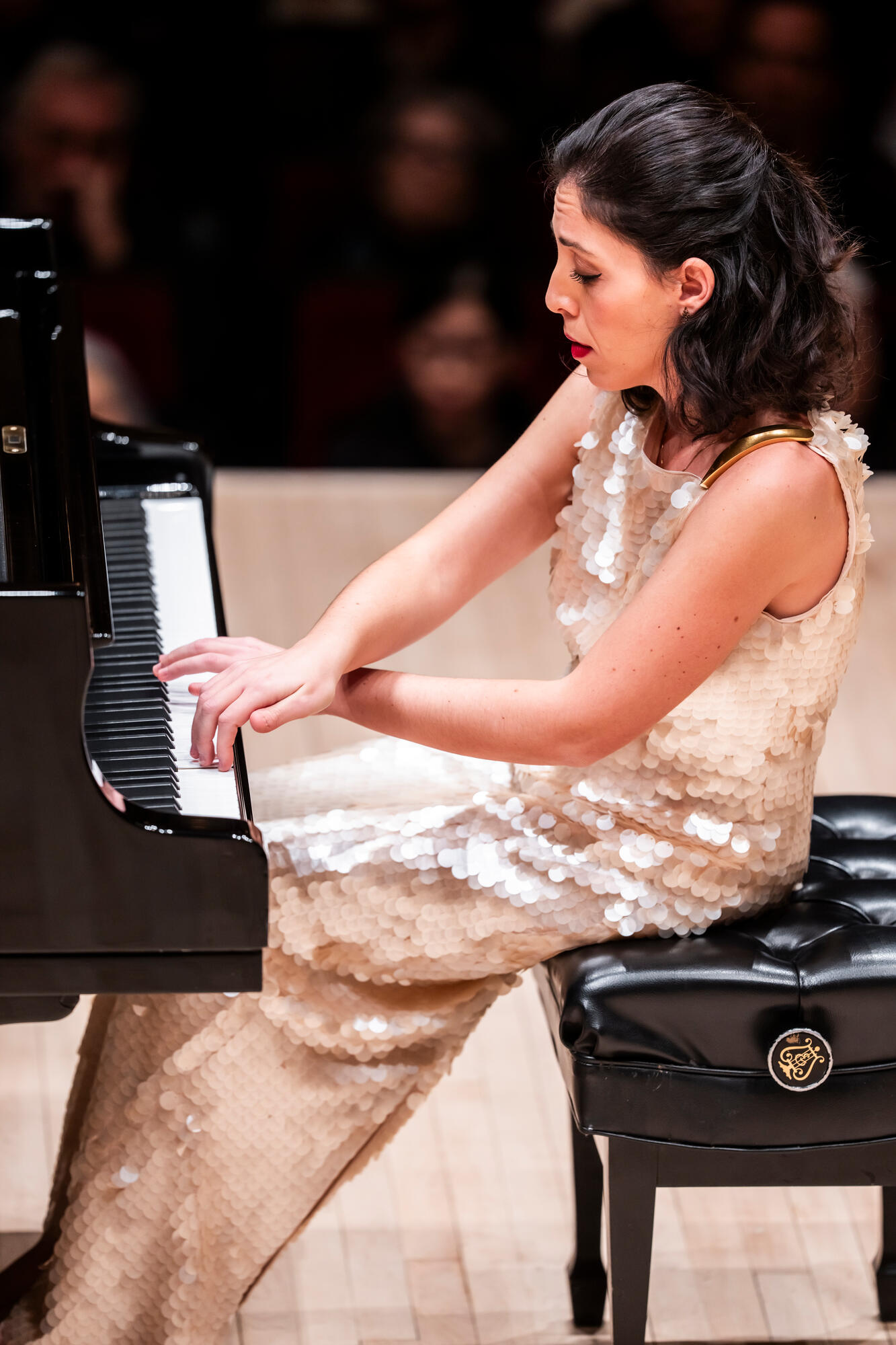
“Great minds think alike” may just be a conversational tagline, but pianist Beatrice Rana’s recital in Carnegie Hall Wednesday night found unexpected points of contact between Sergei Prokofiev and Claude Debussy as they re-invented piano technique for the twentieth century.
What could these two—the sledgehammer modernist from Russia and the weaver of vaporous visions from France—possibly have in common? Plenty, it turns out. Like all great minds, they were forever escaping the pigeonholes others put them in—Prokofiev to explore tender sentiments in the middle of his wartime Sonata No. 6, Debussy to unleash clangorous chords in his muscular etude “Pour les accords.”
Furthermore, each wrote complex, layered music that rewarded the skills of an expert in piano voicing like Rana, most obviously in Debussy’s etude “Pour les sonorités opposées,” a study in contrasting tone colors, but really in nearly every bar of their music.
Those skills came to the fore in the program’s two appetizers, mini-suites from two ballets, Prokofiev’s Romeo and Juliet and Tchaikovsky’s Nutcracker, arranged respectively by Prokofiev and by Mikhail Pletnev. The original scores were marvels of orchestral color, and in these artful and dazzling piano arrangements, as brilliantly executed by Rana, they seemed to lose almost nothing in translation.
Most recital programs ease the listener in with some quiet music to start. But the first sounds heard Wednesday night were the crashing chords and booming octaves of the Darth Vader-ish march from Romeo and Juliet, “The Montagues and Capulets.” After that, the character sketches of “Friar Lawrence,” “Young Juliet” and “Mercutio” provided ample room for Rana’s lighter, even mischievous, side.
In Debussy’s twelve Etudes, Books I and II, his last piano work, the composer systematically explored the novel technique required to interpret his works, while trying, in his words, “to help pianists understand better that one must not approach music armed solely with fierce hands!!” Strong but malleable hands are required for the buzzing fireworks of “Pour les degrés chromatiques,” the first Etude of Book II, turned by Rana into a poem of speed, its chromatic scales spurting in all directions.
Playing her way through the book, Rana decorated a melody in the instrument’s middle register with fanciful arpeggios and slides in “Pour les agréments,” then made fast repeated notes vibrate in midair in “Pour les notes répétées.” A nimbus of piano resonance, bell-like chords, left-hand undulations, booming octaves and a distant flute were just some of the ingredients in the sonic stew of “Pour les sonorités opposées.”
Rana’s exquisite touch made the “compound arpeggios” spray and sparkle in “Pour les arpèges composés,” as a Spanish-sounding tune emerged amidst it all. The chords didn’t just leap and bound in “Pour les accords,” but mellowed to a legato melody at mid-piece; both moods required technical prowess, which Rana had in abundance.
Rana’s ability to evoke instruments of the orchestra seemed to know no bounds in the Nutcracker excerpts: the little horn fanfare and swirling strings of the “March,” the unearthly tinkle of the celesta in the “Dance of the Sugar Plum Fairy” and the cloud of arpeggios surrounding the melody of the “Intermezzo,” which eventually abandoned orchestral mimicry in favor of a Lisztian roar of piano octaves.
Rana swung Prokofiev’s hammer in the opening bars of his Sonata No. 6, pounding out a three-note motto phrase in thirds, unafraid to attack the dissonant chords and thump the bass notes. The second movement, Allegretto, turned to a lighter kind of grotesque, an impish tune dancing over a pulse of quarter notes, decorated with flashes of arpeggios Debussy-style.
Prokofiev marked the third movement Tempo di valzer lentissimo, and indeed Rana made this very slow waltz tend to wander and lose its way, singing a wan little Ophelia-like tune high up in the instrument. The Vivace finale began quietly too, but soon the pianist had the octaves booming and the arpeggios shooting, as the dire three-note motto rang out and the fiery coda sounded a call to arms.
Rana concluded the evening with two encores: a soft, sultry rendition of Scriabin’s Etude in C-sharp minor, Op. 2, No. 1, and Debussy’s Etude “Pour les huit doigts,” with sprays of arpeggios and much graceful hand-crossing.
Carnegie Hall presents pianist Hayato Sumino in works by Bach, Chopin, Gulda, Kapustin, Ravel and himself, 8 p.m. Tuesday. carnegiehall.org
2 Responses to “Piano worlds collide, converge with Rana at Carnegie Hall”
Leave a Comment




Posted Nov 13, 2025 at 11:50 pm by Roderick Spencer Tivel
Clarity, accuracy, control, beauty, love-what a feeling heart she has
Posted Nov 14, 2025 at 7:59 am by Paul
So glad to have heard this Concert up close in Jordan Hall, Boston. Truly a marvel of a pianist. I hope to follow her work for a lifetime.