Look back in Ockeghem: Cappella Pratensis explores the prayerful origins of Halloween
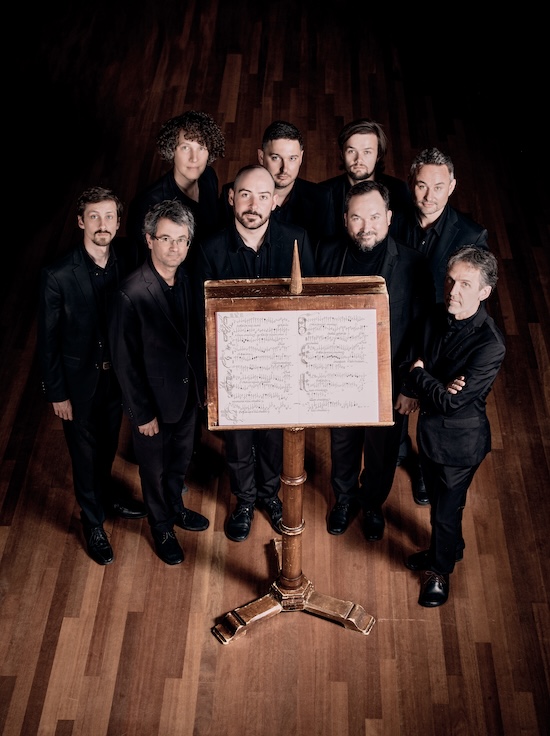
Costumes and candy have morphed Halloween into a cultural juggernaut. In medieval times, All Hallows’ Eve was the start of a three-day Christian commemoration of the dead. At its center was All Saints’ Day, one of the great feasts of the church year. The following day, known as All Souls’ Day, was devoted to prayers for the dead, especially those languishing in purgatory, where sinners expiate their sins to gain admission to heaven.
Music Before 1800 observed the latter at Corpus Christi Church on Sunday evening with “A Requiem for All Souls” with works by Johannes Ockeghem performed by Cappella Pratensis.
For nearly forty years, the Dutch ensemble has focused on performing Renaissance vocal music. The group has several unique attributes, the most notable being that they sing huddled around large choirbooks. For the works performed at this concert, the music is written in mensural notation, used for polyphonic European vocal music from the late 13th to the early 17th century. Mensural notation supplanted plain or Gregorian chant, as it allowed for the greater rhythmic complexity of the emerging genre of vocal polyphony.
In performance, Tim Braithwaite, the ensemble’s artistic director, gestured with his outstretched palms to indicate time. What looked like exercising the joints in his fingers was actually a form of communication with the other singers to indicate rhythm. An upward motion of his hand signaled that a singer was sharp, while a downward motion meant the opposite. Section leaders use similar movements to provide interpretive guidance, including tapping time on each other’s shoulders. Braithwaite notes that all of these practices are documented in medieval sources.
The eight men of Cappella Pratensis stood and sang with unity yet no real attempt at a blend. The countertenors’ ethereal sound floated above the raspy, reedy sound produced by a tenor or two, while the lowest of the basses produced wonderful, cavernous tones. The lack of blend didn’t matter a wit in a performance that resonated with dedication, much like that of the monks who originally sang this music day in and day out for their entire lives without conservatory training.
The core of the program was Johannes Ockeghem’s incomplete Missa pro defunctis, with the three missing sections taken from Pierre de la Rue’s setting. Ockeghem was over 40 years older than La Rue, and the stylistic differences between the two settings of the Mass were apparent. The result was nonetheless a fascinating, homogeneous whole made all the richer through the singers’ careful attention to musical color and texture.
Ockeghem baked in the textural complexities with music for various combinations of voices, while Cappella Pratensis provided the color. The most striking sounds came in the first movements of the Mass, where an upper voice was accompanied by others singing in parallel motion. Further variety came through the grouping of singers in Ockeghem’s passages using contrasting subsets of voices, a device the composer used to illuminate the drama inherent in the words of the Mass. In the final movement that Ockeghem set, the Offertory, the men sang its complex counterpoint with precision and clarity.
Their contemporaries described Ockeghem’s setting as “exquisite and most perfect” and La Rue’s as “the most harmonious music you could ever hear.” Cappella Pratensis did indeed summon the beauty of singer La Rue’s polyphony, as well as its depth of emotion. If Ockeghem had favored the higher voices, Cappella Pratensis’s basses gloried in La Rue’s preference for the opposite extreme.
The Missa pro defunctis was bookended by two secular works, although the distinction between sacred and profane was often more a matter of form than substance in medieval times. The first was Ockeghem’s ballade Mort tu as navré de ton dart composed to honor the Franco-Flemish composer and singer Gilles de Bins dit Binchois at his death in 1460. The motet was similar to Ockeghem’s Mass setting, with its emphasis on a part for solo voice, which countertenor Korneel van Neste projected with an ethereal sound and otherworldly aura. The final section, with its prayers for eternal rest for the deceased, resounded with higher, brighter, more complex textures brilliantly executed.
The humanist Erasmus mourned Ockeghem’s death in 1497 with the words, “Has it then fallen silent, the golden voice of Ockeghem?” The final work was Josquin des Prez’s Nymphes des Bois composed in honor of the deceased composer. It, like Ockeghem’s ballade, was performed in an approximation of the fifteenth-century French Latin. That alone gave it a special air, but it was the men’s voices that imparted the piece with exquisite sadness. The finest were the musical teardrops by which they painted the weeping of Ockeghem’s fellow composers over the loss of their colleague, and the final desolate, parched “Amen.”
Music Before 1880 presents violinist Shunske Sato directing Juilliard415 in “Christmas at a Leipzig Coffeehouse,” 5 p.m., Dec. 7 at Corpus Christi Church. mb1800.org
Leave a Comment