Galilee Chamber Orchestra brings a mixed night of “peace through music” to Carnegie
Carnegie Hall is associated in the public’s mind chiefly with music, but since Andrew Carnegie founded it in the 1890s this institution has dealt as much in issues and ideas as in sharps and flats. The lofty ideal of “peace through music” has found a lasting home there, most recently through presentations of orchestras made up of musicians from ethnic groups who, despite their joint efforts on behalf of Bach and Brahms, were perceived as only hurling bricks and bombs at each other.
Daniel Barenboim’s West-Eastern Divan Orchestra has brought Arab and Jewish musicians together on the Carnegie stage, and youth orchestras from many (not always friendly) countries cheered each other on at the hall’s World Orchestra Week (WOW!) festival in August 2024.
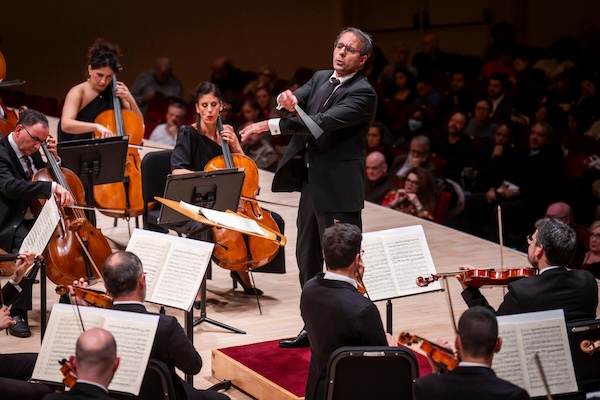
The Galilee Chamber Orchestra, an ensemble that comprises roughly equal numbers of Arab and Jewish Israelis, made its Carnegie Hall debut in 2022 and returned Thursday night, led by its founder and music director Saleem Ashkar, with a new piece from Israel and familiar masterworks by Mozart and Mendelssohn.
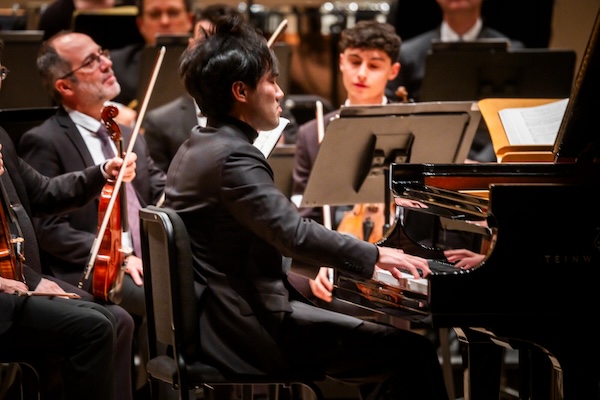
Like those other diplo-ensembles, the Galilee group was warmly welcomed by the Carnegie audience, but the loudest cheers were reserved for pianist Bruce Liu and his mellifluous rendering of Mozart’s Piano Concerto No. 23 in A major, K. 488.
In the traditional opener spot was a nine-minute vignette titled nocturnal whispers by an Israeli Palestinian composer, Nizar Elkhater. In the most noncommittal of program notes, the composer offered an enigmatic observation or two and described the piece as “a sonic meditation on memory, presence, and the elusive nature of meaning.”
As to what the piece was actually “about,” one was left with the evidence of one’s own ears. And what one heard was a nightscape in the Bartók tradition, all rustles and hums and a solitary bird here and there, with a stirring of strings or a glow of brass to hint at human strivings distantly remembered. Ashkar and his players realized this elusive score with admirable concentration and a sense of atmosphere.
More of that concentration would have been welcome in the orchestral exposition of the Mozart concerto, which sounded a bit ragged and rushed. Soloist Liu’s entrance put matters on a firmer footing, as he shaped phrases and runs authoritatively in what was overall a rather introspective performance.
The Elkhater piece heard earlier found a soul mate in this concerto’s dark Adagio, a midnight meditation that benefited from a steady pulse and a songful line arising in the piano. The finale overflowed with bright Mozartean ideas, with Liu still preferring a gracefully tapered phrase over anything more assertive.
As if to compensate for his somewhat self-effacing concerto performance, Liu played an ebullient Mozart encore, the Overture to The Marriage of Figaro in a sparkling piano arrangement by Sean Chen and himself.
The program closed with a spirited performance of Mendelssohn’s Symphony No. 3 in A minor, the “Scottish” Symphony. Along with the inspiring sight of Israeli musicians of different heritages making music together, one wished for a little more attention to balances, so that horn or wind parts didn’t stick out at inappropriate times, sometimes covering the main tune in violins or cellos.
However, the orchestra’s lightning strings and keening woodwinds captured the second movement’s unusual character, somewhere midway between the fairy dust of A Midsummer Night’s Dream and a boisterous Beethoven scherzo. The Adagio moved to an inexorable dotted pulse, although it was sometimes hard to tell which instrumental line was meant to be featured in the orchestral mix. The finale too would have benefited from winds stepping forward when it was their turn and backing off when the strings were “on.”
Still, Mendelssohn’s splendid closing chorale seemed just the right note on which to end this evening of peace through music.
Carnegie Hall presents the Pittsburgh Symphony Orchestra, conducted by Manfred Honeck with pianist Seong-Jin Cho, in works by Lera Auerbach, Rachmaninoff and Shostakovich, 8 p.m. Dec. 3. carnegiehall.org
Leave a Comment