Cage match: Aimard frames Benjamin premiere within a century of piano music
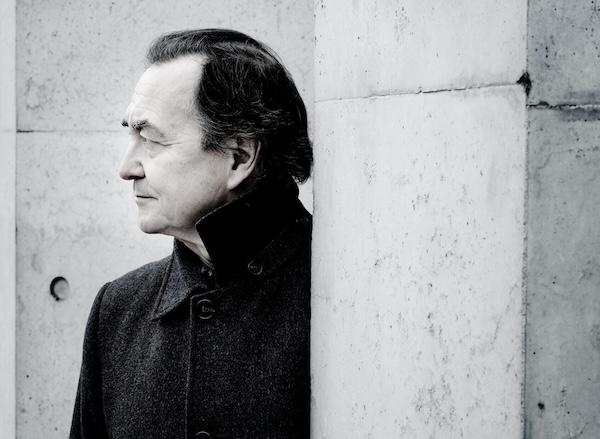
The night after Jean-Efflam Bavouzet played Le Tombeau de Couperin—and more Ravel—in Alice Tully Hall, another French pianist played the same piece. That musician was Pierre-Laurent Aimard, the venue was 92NY, and the context was vastly different.
Indeed, this concert was nearly all context. The feature was the New York premiere of George Benjamin’s DIVISION, for piano four-hands, with Benjamin joining Aimard for the performance. Before that came the context, what Aimard described as the “cage” that he and Benjamin devised to prepare for and display the new work: music by Nikolai Obukhov, an earlier Benjamin piece, Pierre Boulez, and Le Tombeau.
That goal, putting together something like a playlist of music that creates a mutually supporting environment, should be more prevalent than it is, especially after Wednesday night’s demonstration of just what that can do. In front of an enthusiastic but surprisingly small crowd sprinkled with prominent artists, Aimard got past just “liking” a concert to experiencing a bit of the ongoing aesthetic argument that is classical music.
This was “hearing music,” played not only with polish and exactitude but at times an almost hammering energy, that had different ideas about how musical language should work. It was a look at how different composers used the same basic materials of vocabulary and grammar—pitches, intervals, rhythms—to speak with different styles.
The most startling work was Obukhov’s 1916 Révélation, not only for its obscurity but how it spoke to the other works. An unusual post-Scriabin modernist, Obukhov wrestled with both atonality and a driving mysticism that had him inventing both notational systems and instruments. This piano piece has an absolutely unique sound, in a liminal space between atonality and dissonant tonality, with brief, pathos-drenched lyrical phrases rippling through. It’s not a technical exercise, though, sections like “Mort” and “Détresse de Satan” explain the expressive purpose.
Deeply fascinating, and with a striking performance from Aimard, it set the stage for Benjamin’s Shadowlines-Six Canonic Preludes. If Obukhov was trying to force his inner life through music, in this work Benjamin was trying to unsettle strict canonic methods, the musical phrases not just repeating and following each other but colliding and overtaking each other. This is music about unsettling language, and Aimard played it with the type of command that made it sound spontaneous.
This first half of arguments finished with Boulez’s Sonata for Piano No. 1, an inherently querulous work. The previous piece disassembled canons, this one takes apart the very notion of tonal and formal organization. Extreme changes in manner, with all the music pushed to the same surface level, put a premium on Aimard’s playing. Beyond his technical control, the pianist’s thinking was impressive, treating each moment as equal to the others.
This wild first half was followed by a more placid, but no less weighty, second. Le Tombeau was muscular in a way that the previous night’s performance was supple, Aimard playing with a sense of verticality, the phrases in the “Prélude” and the “Forlane” set out in blocks, the fugue with an emphasis on structural organization rather than flow. If the previous music was about exploding language, this performance was about bringing those shards back into a vernacular.
With two players at the same keyboard, DIVISION is a physical conversation through music, Aimard and Benjamin cooperating and, at times, conflicting not just through sound but in space. In a kind of opposite-canon, the two often play unrelated music ideas simultaneously.
That’s not all it was, however. Beginning with a cryptic blues, the music travelled the furthest through moods of any other piece on the evening. The balance between cooperation and antagonism built to a suspenseful climax, hanging in the air as one was eager to hear how it would resolve. It did so with exciting force, Aimard rippling through fast, high phrases while Benjamin pounded bass notes. As challenging as the first hearing of something can be, one wanted to immediately hear this again.
The Curtis New Music Ensemble plays Valerie Coleman, Carlos Simon, and others 7:30 p.m., November 21 at 92NY. 92ny.org
Leave a Comment