The Sebastians celebrate the spooky season with a walk on Baroque’s dark side
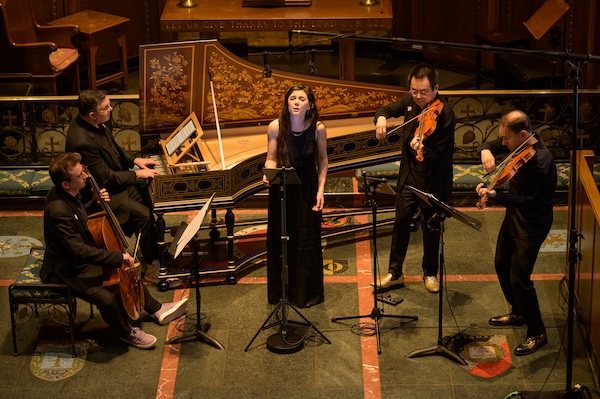
There were no jack-o-lanterns or skeletons adorning the chapel of Brick Presbyterian Church Saturday evening, but the early-music ensemble The Sebastians left no doubt what season it was with a program of dark-hued Baroque music, featuring the intensely expressive voice of soprano Lucy Fitz Gibbon.
Horror, death and abandonment were the themes of cantatas by G.F. Handel and his older contemporary Michel Pignolet de Montéclair. Whoever summarized the genre of opera as “the undoing of women” could have started with these masterful 20-minute dramas, recounting respectively the rape and honor-suicide of the Roman wife Lucretia and the sorceress Armida’s anguish as she watches her lover Rinaldo sailing away, despite the storm she summoned to prevent it.
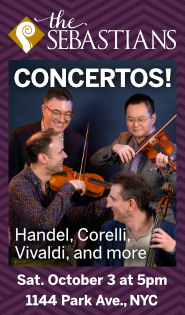
Like horror movies that begin on a sunny day and emerge chastened into the light at the end, Sunday’s program began and ended with cheerful trio sonatas by Handel and Corelli. Between the two cantatas, however, The Sebastians—Nicholas DiEugenio and Daniel Lee, violins; Ezra Seltzer, violoncello; and Jeffrey Grossman, harpsichord—offered strange and disturbing visions from the pen of a little-known Venetian at the very dawn of the Baroque, Dario Castello.
The five brief movements of Handel’s Trio Sonata in A major, Op. 5, no. 1, showcased The Sebastians’ suave mastery of high-Baroque style in a gracefully walking Andante, a scampering Allegro, a sweetly pathetic Larghetto, another catch-me-if-you-can Allegro, and a smartly danceable Gavotte, all wrapped up in a little over seven minutes.
The cozy confines of the Brick Church chapel proved a near-ideal place to hear chamber music, accommodating something over 100 listeners in a space resonant enough to let the sound bloom but not so much as to blur the fine details of the artists’ performance. The silvery, penetrating tone of the Baroque violins received gruff support from the violoncello, and for once the harpsichord actually sounded loud.
An audience in 2025 may have difficulty relating to the story of a wronged wife killing herself to preserve the honor of her husband and of Rome, a fact acknowledged in introductory remarks by Grossman, the group’s artistic director. Yet creators from Shakespeare to Britten have found meaning in it, and Montéclair’s cantata La morte di Lucretia, published in 1728, throbbed with emotions from rage to despair to tender concern and ultimately heroic resolve.
The voice in the text alternated between a narrator and Lucretia herself, a fact subtly reflected in soprano Fitz Gibbon’s superb performance. As she imaginatively inhabited the text, her tone was mostly pure and straight yet full-bodied, slipping into vibrato at the work’s most operatic moments.
The clash and joining of straight soprano tone and two Baroque violins produced acoustic effects unknown to composers of later eras, making Montéclair’s chromatic harmonies even more vividly expressive.
The foundation for those harmonies may have been laid a century earlier in Venice by composer Castello, about whom almost nothing is known, not even his birth and death dates. However, in 1629 he published Book Two of “Chamber sonatas in the modern style.”
And how! As demonstrated Saturday, these radically experimental pieces proved that “stream of consciousness” didn’t originate with James Joyce, and Arnold Schoenberg was about three centuries late with “liberation of the dissonance.”
Catering to the Venetian appetite for anything bizarre and untrammeled, Castello’s “Sonata nona” fluctuated constantly from allegro to andante and from banter among the strings to something like a jazz bass solo for the rampaging violoncello, all amid fractured harmonies for which the word “chromatic” seemed inadequate.
One might hope that order would be restored by the arrival of George Frideric Handel, but that hope would have been in vain Saturday, as the cantata Armida abbandonata found the sturdy Saxon channeling his inner Castello to enter the disordered mind of the jilted sorceress, as she summoned tempests and sea monsters one minute and blamed herself the next.
True to the material, the string players employed a kind of sliding legato that went beyond the notes on the page to produce a multitude of tiny clashes and expressive dissonances. For her part, Fitz Gibbon did full justice to Handel’s gorgeous vocal writing, drawing out the lines like molten glass.
The group’s managing director Karl Hinze sent the audience on its way with the promise of “a little slice of heaven” for the last item on the program. The players served that slice, Corelli’s Trio Sonata in D major, Op. 3, no. 2, with the same grace and vivacity as in the opening Handel sonata. And yet a little slide legato here, a modulation to the minor there, served to remind the listener of the dark doings that had gone before.
The Sebastians will perform works of Handel, Boyce, Castrucci, Pepusch, Geminiani, Corelli, Arne and “Mrs. Philharmonica” with projections of historical views of London,” 5 p.m. November 8 at Good Shepherd-Faith Presbyterian Church. sebastians.org
Leave a Comment