The Orchestra Now recalls forgotten composers from a turbulent era
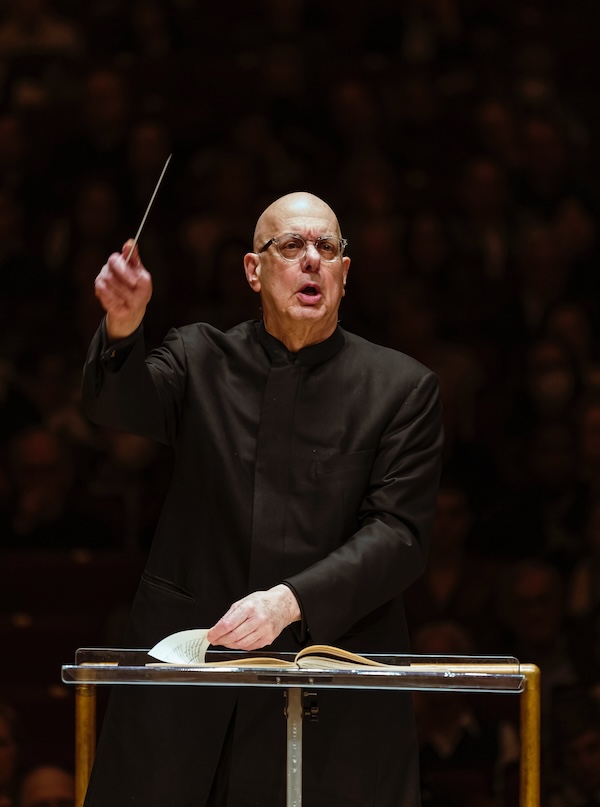
The Orchestra Now, the ensemble of Bard College’s master’s degree program in orchestral performance, led by Leon Botstein, opened its Carnegie Hall series Monday with a program tantalizingly titled “Creative Resistance to Empire.”
Lesser-known composers from Ukraine, Moravia, and Lithuania were represented, and publicity for the concert spoke darkly of “cultural struggles resulting from the oppressiveness of the Russian Empire.” Could cries of “Free Mikalojus!” and “Unhand Vítězslava, you fiend!” be far behind?
But really, if you want resistance drama, think Shostakovich sweating out the premiere of his Fifth Symphony with Stalin’s chains clanking in the wings—not the undulating sylvan scenes of Miške (In the Forest) by the tone colorist (and actual painter) Mikalojus Konstantinas Čiurlionis, or the exuberant razzle-dazzle of Vítězslava Kaprálová‘s Military Sinfonietta.
And how about those notorious dissidents, Nikolai Rimsky-Korsakov and Pyotr Il’ych Tchaikovsky? Perhaps it was possible that the Tsar and his family, who spoke French at home, found the robust tunes in Rimsky’s fantastical Overture on Three Russian Themes not to their taste. But what was not to like about Tchaikovsky’s apotheosis of “God Save the Tsar” in the bombastic Festival Coronation March (other than the fact that his treatment of “La Marseillaise” in the 1812 Overture was far more thrilling)?
To be fair, Ukraine’s Borys Liatoshynsky did feel the heat from Soviet critics for his anti-war Symphony No. 3 of 1950, coming so soon after the Great Victory over the Nazis. In fact, until the fall of the U.S.S.R. in 1991, the work was heard without its original title (“Peace Will Defeat War”) and with a substitute finale more to the authorities’ liking.
And in a general way, these works, dating from the middle of the 19th century to the middle of the 20th, outline an era when the lands of Eastern Europe were much fought over, when place names and nationalities seemed to change weekly.
And the composers themselves were on the move, from Brno to Prague to Paris, from Vilnius to Warsaw to Leipzig to St. Petersburg, sometimes just ahead of Soviet or Nazi armies. “Creative response to empires,” at least, was certainly what they did.
As a member of the Russian Navy, Rimsky-Korsakov was acquainted with some of the machinery of empire. But the empire of his Overture, which opened Monday’s program, was one of fantasy, a magical world of curlicues of themes interacting with the sturdy “Slava” tune many people know from Boris Godunov or one of Beethoven’s “Razumovsky” string quartets. (Unfortunately, a stalled train made me late to the hall Monday night, so I can’t comment specifically on this orchestra’s performance of the piece.)
Similarly, human power struggles seemed a thousand miles away in the hush and rustle of Čiurlionis’s forest piece, composed a generation later, in 1901. As a spiritualist and a synesthete who saw colors in musical sounds, this composer was a soul brother to Scriabin, and his attraction to turn-of-the-century Symbolism linked him to Debussy, but this music sounded like neither.
Instead of fiery passion or lush sensuality, it exuded a kind of rhapsodic peace, strings soaring easily amid glints of brass and sprays of harp, clarinet, flute. A single strand of music that swelled and dwindled without contrasting episodes, Miške offered an aural correlative to the composer’s paintings, with their strong colors, blurry outlines and enigmatic figures.
Before she was felled by disease at just age 25 in Montpellier, France in 1940, composer and conductor Vítězslava Kaprálová had made quite a splash in the man’s world of Czech music, counting among her fans conductor Rafael Kubelik, composer Bohuslav Martinů and pianist Rudolf Firkušný. The Military Sinfonietta, apparently named after Janáček’s patriotic work of 1926, was her graduation piece from the Prague Conservatory in 1937, as war clouds gathered over her native land.
But instead of Janáček’s defiant stance, Kaprálová seemed almost playful in her one-movement piece, opening with a flurry of brass and a quick march, but soon disintegrating into fragments of phrases, then skipping to a most unmilitary 6/8 rhythm.
Tender violin solos alternated with booming timpani and rattling xylophone. The young composer’s virtuosity in orchestration was evident not just in the incandescent tutti but in the pianissimo episodes of muted brass, piccolo and harp. All players, especially the strings, marked out the shifting rhythms with verve, until the music broadened into a triumphant final tune and a slam-bang finish.
As Russia’s most famous composer and a favorite of the Tsar, Tchaikovsky was the obvious choice to compose the march for the coronation of Alexander III in 1883. He took the commission reluctantly—it must have seemed to him all risk and little reward—and in Monday’s performance the resulting work had the feeling of a few of the composer’s trademark crescendos strung together to fit a specified time slot in the ceremony. But no question, Tchaikovsky still knew how to thrill listeners with brass climbing over a suspenseful timpani roll.
In the Stalin era, there was room for only one Shostakovich, skating on the edge of official disfavor, his genius silencing his critics (most of the time). Composers from more far-flung Soviet lands such as Khachaturian and Liatoshynsky could find refuge in exotic folk idioms for a time, but when the latter put his head up with a “peace” symphony there was trouble.
On Monday there was no mistaking the “Guernica”-like imagery of the symphony’s first movement, beginning with dire horn and brass calls, then the desperate pleas of oboe and clarinet answered by stern strings. Between shrill tutti climaxes, episodes evoked queasy fear in string harmonics and screaming shells in piccolo and clarinet.
A desolate Andante con moto followed, first with drooping phrases in muted strings, then with a horn ostinato driving the strings into an anguished outpouring, before the scene dissolved into soft sighs and shudders.
The fast, biting scherzo opened in a blaze of brass and percussion, then dropped to an urgent whisper. A tender interlude for violins and bells gave way to an all-out battle of strings, xylophone and percussion with flute fireworks before the movement evaporated in a wisp of piccolo.
The symphony’s original finale celebrated the “attainment of peace,” as the program note by orchestra member Carlos Torres put it. But Monday’s performance, billed as the original, sounded curiously like the “forced rejoicing” of the alternate finale, as a bold march and stair-step climaxes à la Tchaikovsky seemed to celebrate victory more than peace. Apparently peace comes in all colors, including a massive fortissimo finish reminiscent of “The Great Gate of Kiev.”
The young musicians executed the entire program with superb precision and imaginative phrasing, making every moment count. Their ensemble sound was balanced and clear, the solos vivid. The orchestras of America and the world will be lucky to have them.
One wished only that conductor Botstein had led them on a more compelling musical journey through each piece, so that climaxes really paid off and endings brought satisfaction, not just silence. But as always with this conductor’s exploratory programs, it was a pleasure to make new acquaintances in the vast world of orchestral repertoire.
The Orchestra Now, conducted by Zachary Schwartzman with tenor Ryan Michki, will perform music by Richard Strauss, Vaughan Williams, Purcell (arr. Stucky) and Barber, 4 p.m. Nov. 23 at Symphony Space. Admission free, RSVP requested. ton.bard.edu
Leave a Comment