Piece by “Squid Game” composer lifts routine outing from Seoul Philharmonic
Orchestras on tour are out to impress. They put together programs that show off both their musical skills and their taste, give them extra rehearsal time, and often bring along a star soloist for a concerto performance.
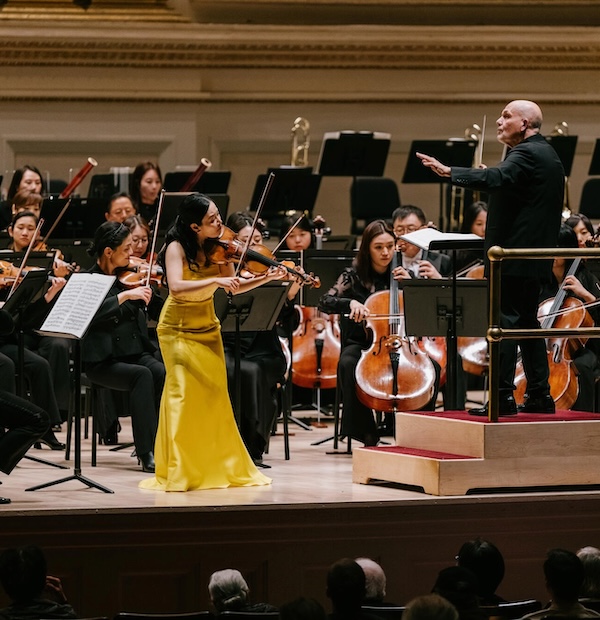
On paper, the concert that the Seoul Philharmonic Orchestra and music director Jaap van Zweden brought into Carnegie Hall was decidedly unshowy, in fact mostly generic. In the standard overture/concerto/ symphony format, they played the U.S. premiere of a 2025 composition by Jung Jae-Il, Mendelssohn’s Violin Concerto, with soloist Bomsori Kim, and after intermission Rachmaninoff’s Symphony No. 2. With such a conservative set, one hoped the playing would show exceptional mastery and some refreshing insights.
On those terms, one was disappointed. This was a mainstream set of pieces played by a solid but, at least in this concert, undistinguished orchestra. There were some strengths, and nothing was ever bad, but neither was anything particularly notable, much less memorable.
The single exception was the opening Inferno from Jae-Il. At his core a jazz musician, Il is known for his scores to the movie Parasite and the Netflix series Squid Game. This was an impressive piece inspired not by Dante but the final section of Italo Calvino’s Invisible Cities.
Inferno announced itself with a series of enormous, complex, gnarly chords, like the opening harmonies of Don Giovanni expanded in myriad directions. Following this was a long, beguiling, expressive melody, finely crafted and structured, that showed off the robust and slightly dark sound of the orchestra’s strings. This was evocative, colorful music. A faster, motoric section cruised with van Zweden’s typical drive, but unlike the elegantly shaped first section, didn’t quite have the inner workings to completely sustain its duration. But the final section, again slow, was as skillfully written and attractive as the first.
Along with the beautiful craft—a sense of form and balance through which everything felt logical and right—there were personal quirks and surprises, like a touch of Ralph Vaughan Williams and an ending that was deliberately inconclusive but so gentle that it felt satisfying. Most impressive of all was that the piece wasn’t cinematic in the way of telling one what to feel, instead it was full of palpable, communicative expression that allowed one to decide how to feel about it.
In Mendelssohn’s concerto, Kim played with a lovely tone, a slicing, singing sound to start the piece in the upper register that alternate with a throaty quality when she bowed the G string. She also seemed to be pushing very hard to do something with the music, though it was never clear exactly what she was trying to do.
That may be why she used so much legato in the first movement that she often neglected to articulate several notes. She also stretched and overemphasized phrasing, often heading in a very different direction than the orchestra. She played with such a heavy vibrato in the second movement that the wonderful simplicity of Mendelssohn’s melody was buried. The finale was more successful for everyone, was well played with a sense of ease and fun.
Her encore, Kreisler’s “Schön Rosmarin” from Old Viennese Dances, was similarly frustrating, showing an artist seeming to argue with herself over how to wring expression from each line, and ending up in a confused, liminal interpretive space.
The Rachmaninoff symphony was there to put the orchestra on full display, and what one heard was a solid group under an energetic conductor that has plenty of strength and spirit but no distinguishing ensemble or interpretive qualities. This was a kind of fervent blandness, a clear and proud commitment to being absolutely orthodox.
Outside of the muscular strings—and a particularly good viola section—the winds and bass had no idiosyncrasies of color or character, and rather then balance all of this van Zweden put it into a big block of sound. One was impressed with its dimensions and mass but one felt very little of anything was coming through
There was pleasure in hearing Rachmaninoff’s ideas flow through time, and the energy of this performance, and the fundamental instrumental skill, meant that he spoke with force, but beyond the image had nothing to say.
The quick encore of one of Dvořák’s Slavonic Dances was—after Jae-Il’s piece—the most satisfying thing of the night, straightforward playing serving straightforward music.
The Philharmonia Orchestra, with conductor Marin Alsop and pianist Alexandre Kantorow, play Tchaikovsky, Prokofiev, and Bartók 8 p.m., Tuesday. carnegiehall.org
One Response to “Piece by “Squid Game” composer lifts routine outing from Seoul Philharmonic ”
Leave a Comment

Posted Oct 29, 2025 at 5:24 am by Reiner Gelb
The review, of course, reflects one individual’s personal opinion and taste — which is absolutely fair. But journalism should also balance opinion with facts.
Regarding the encore, it would have been accurate to mention the full title. It was not the original version of Schön Rosmarin, but a special solo arrangement written for Ms. Kim by a violinist and member of the Bamberger Symphoniker. The audience responded with huge applause — an important fact showing how warmly her performance was received, both for the concerto and the encore.
It is also factually incorrect to claim that Ms. Kim used “heavy vibrato” in the second movement. Quite the opposite — she consciously employs a natural, often non-vibrato tone, which was also noticed by several professional violinists in attendance. This stylistic choice reflects her deep understanding of Mendelssohn’s simplicity and purity, not a lack of control.
Ms. Kim is one of the leading violinists of her generation, performing frequently in Europe with major orchestras and conductors, including those known for historically informed performance. Her interpretations of Mozart, Beethoven, and Mendelssohn have been praised for their clarity, sincerity, and stylistically informed approach.
Finally, when describing the orchestra, it would also have been fair to mention that the concert took place in a fully packed Carnegie Hall and received standing ovations. The audience’s enthusiastic response clearly showed that many listeners experienced the evening quite differently from how this review suggests.