Parlando explores the concept of “Bildung” in season opener
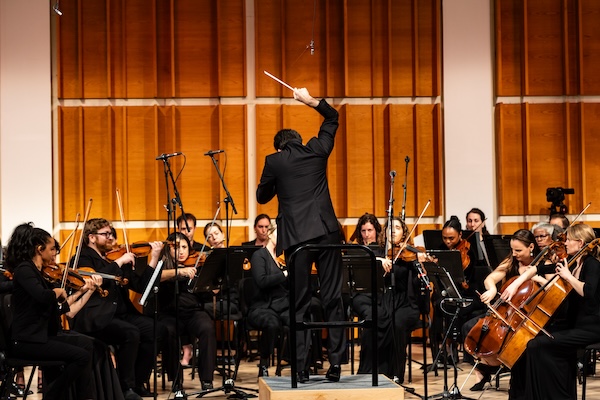
A Parlando concert is what would be called in academic music circles a lecture-demo: the music is used to illustrate and illuminate an argument or narrative, and vice versa. Conductor Ian Niederhoffer introduces each piece in extended remarks from the podium.
The narrative for their season opener, titled “The Broken Promise,” was that of the rise and fall of Bildung in German musical culture. Niederhoffer somewhat confusingly summarized the concept as asking the question “Can art make you a better person?”
This is something of an oversimplification: Bildung more properly refers to personal and societal growth through education, philosophy and self-reflection, of which art can be an important part. Still, Niederhoffer is an engaging speaker, and his introductions are peppered with historical anecdotes and context, which can be fascinating.
Felix Mendelssohn’s Son and Stranger Overture, which was presented as exemplifying the optimistic promise of Bildung, is a pleasant enough piece, with occasional flashes of ingenuity, if not among Mendelssohn’s masterworks. Niederhoffer made as good a case for it as could be made, emphasizing rhythmic vitality and making the most of the strings’ rich section sound. Occasional balance issues and slightly muddy transitions can be attributed to a lack of rehearsal time for the shortest piece on the program. The orchestra’s members show the extraordinary depth of New York’s freelance music scene.
Certainly none of those issues were apparent in Franz Schreker’s The Birthday of the Infanta Suite, a short ballet score based on a fairytale pastiche by Oscar Wilde. The story tells of a dwarf who dances for a princess, falls in love with her and dies of a broken heart when she rejected him. Niederhoffer pointed out the parallel with Schreker’s career, contributing to German culture as a wildly successful composer, only to be condemned by the Nazis and perish shortly afterward.
The piece itself is an early 20th-century riot of orchestral color in a cheerfully incoherent succession of moods ranging from the sublime to the grotesque.
Niederhoffer shepherded the orchestra along this winding path with enthusiasm and commendable clarity. Waltzes had a lovely sweep; melodic sections went with earnest sentimentality without becoming mawkish. Floating textures and furioso passages were equally clear and convincing. A slight flattening of the sound acoustically at the loudest climaxes raised the question of whether Parlando may have outgrown Merkin Hall, which is best suited to chamber music.
Richard Strauss’ Metamorphosen for 23 solo strings was written during the last days of World War II as a requiem for German culture, and by implication for Bildung. The introductory remarks recounted Strauss’ attempts both to stay apolitical and to save his Jewish daughter-in-law’s family, none of which were successful.
Niederhoffer took the piece at a remarkably brisk tempo for an elegy, and emphasized drama and pathos at the expense of Strauss’ rich, complicated counterpoint. As a result, while some of the climactic moments were effective, particularly the rising canon toward the end, the structural logic wasn’t always clear and the overall impact were blunted. The full string sections, when they played as sections, had rich intense sounds, but the subtleties of the various smaller combinations of instruments were left unexplored.
Parlando presents “Crossing Over,” 3 p.m. December 7. parlandonyc.org
David Wolfson holds a PhD in composition from Rutgers University, and has taught at Rutgers University, Montclair State University, Penn State University and Hunter College. He has composed music in most classical genres as well as musical theatre. You can find more information at davidwolfsonmusic.net.
Leave a Comment