Met’s beloved “Bohème” opens with youthful appeal, vocal richness
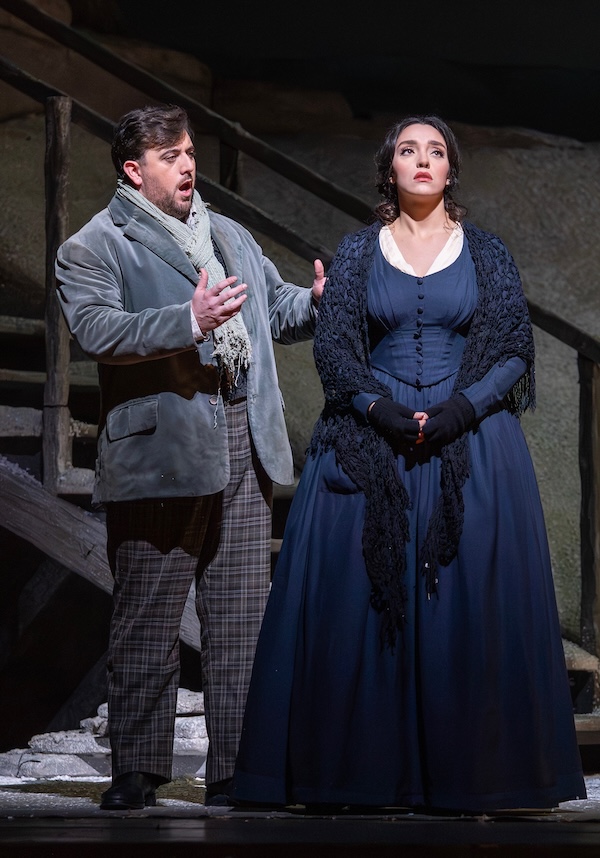
La Bohème returned to the Metropolitan Opera on Tuesday evening. Throughout the run, rising stars make debuts in various roles, and none were more anticipated than those of Juliana Grigoryan and Freddie De Tommaso as Mimì and Rodolfo.
Franco Zeffirelli’s production retains its grandeur and power after over 500 performances since its debut in 1981. When the curtain rises on the Café Momus, applause erupted as it always does. Oddly, there was none for the reveal of the wintry early morning scene at the Barrière d’Enfer—one of the most beautiful visual moments in all of opera. Another surprise was the number of young people in attendance, including children.
Juliana Grigoryan is a graduate of the Met’s Lindemann Young Artist Development Program, but a newcomer to its stage. Her only prior appearances in the house were two performances as Liù in Turandot in March 2024. Physically, Grigoryan has all the attributes of the ideal Mimì, a dark beauty with a winsome demeanor, which conceals a cunning will. It is she who knocks on Rodolfo’s door, candle in hand, not the young poet appearing at her threshold.
Grigoryan has a fascinating, richly textured, supple soprano that spins effortlessly through the house. It is not only the beauty of her voice that makes her Mimì so appealing, but the colors she employs to illuminate the seamstress’s emotional trajectory. Grigoryan began ‘Sì, mi chiamano Mimì’ with an unassuming dignity, as she described her simple, solitary life embroidering flowers. When she sang of spring, however, the voice bloomed and took flight, and it continued soaring all night.
De Tommaso debuted at the Met as Cavaradossi in Tosca last season. The lower range of his voice has a rich, baritonal quality, but the top is shining and true. He interjects an element of risk in his approach to high notes by lunging at them and taking a moment or two to let them settle. When they do, the effect is electrifying, providing a jolt to Rodolfo’s expansive expressions of love. De Tommaso’s Rodolfo can be prickly, even brusque, but his poet has passion.
The rest of the cast are regulars in the Met’s revolving lot of Parisians. Each foursome of struggling young bohemians has its own dynamic, and this one was more nuanced than most. The hijinks were there, but there was a seriousness, too, provided by Lucas Meachem’s jealous, yet stoic Marcello. Meachem anchored the cast, not only with his presence, but also with his smooth, firm baritone.
With his ready smile, Jongmin Park’s Colline is a lighter-spirited philosopher than most. He bid farewell to his beloved overcoat with dignity and compassion, giving particular attention to phrasing and dynamics. Sean Michael Plumb has become one of the Met’s go-to Schaunards, and his characterization gets richer and nuanced with each repetition. His singing in the first act was notable for the fine shadings and colorings that he employed. In the last one, he brightened the stage with his preposterous dance moves. Hopefully, soon, Met audiences will hear him promoted to Marcello. Donald Maxwell returned in his richly detailed comic turns as Benoit and Alcindoro.
Heidi Stober was a high-spirited and compassionate Musetta. Stober’s voice had admirable sparkle, and her character all the glamour and spunk to make “Quando me’n vo’” pop, and Musetta’s third act sparring with Meachem’s Marcello flare. The soprano was at her most effective, however, in the final act, where her quiet prayers were sung in a mere whisper above the shimmering sound of the Met Orchestra, playing as softly as imaginable.
Keri-Lynn Wilson was conducting La Bohème for the first time at the Met, but she exhibited a total command of the score. Standing tall on the podium, Wilson has a bold, athletic conducting style to which the orchestra responded instinctively. Puccini’s melodies soared, and prayers were sung above a perfectly balanced and paced performance laden with emotion. Once again, La Bohème cast its spell at the Met.
La Bohème runs through May 2. Angel Blue and Stephen Costello assume the principal roles on Nov. 30, with Aleksandra Kurzak and Adam Smith as the season’s final pair of lovers opening on April 11. metopera.org
Leave a Comment