Dudamel, Philharmonic take a step forward with season-opening program
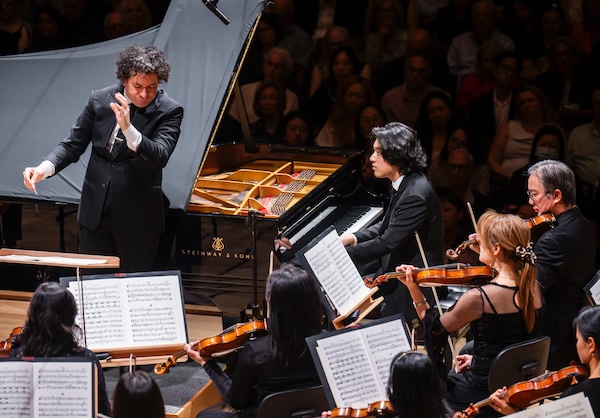
The earth will circle the sun once more before Gustavo Dudamel becomes the New York Philharmonic’s music director. In the meantime he does hold the new (and awkward) title of “Music & Artistic Director Designate.”
Title details seem irrelevant in the face of the obvious burgeoning relationship between conductor and orchestra, and a significant step forward was taken Thursday night with the opening concert of the 2025-2026 season.
The orchestra premiered Leilehua Lanzilotti’s of light and stone, Yunchan Lim played Bartók’s Piano Concerto No. 3 and after intermission Ives’ Symphony No. 2 was heard in David Geffen Hall.
As the concerts that finished the previous season demonstrated, Dudamel and the Philharmonic are already closely knit collaborators. And as Thursday’s concert showed, this is still a process, one that seems to be unfolding naturally. The common spirit—an excited hurrying into the future—was there, but the thinking for the whole concert and within some of the pieces was sometimes scattered.
Lanzilotti’s of light and stone had the virtues and faults of the concert rolled into one. As a composition, it was both awkward and sublime, caught in between a narrative from Hawaiian history, sound pictures from the islands, and just notes working together. The beginning was attractive, a gentle and glowing fanfare that made the most of simple ideas. But the piece soon bogged down in a literal sense, the music completely stopping several times. This perhaps had something to do with the programmatic depiction of bringing electric light to Hawaii, but it also meant it all ran aground.
The composition takes several fits and starts to get going again. The pictorials didn’t work, nor was there clear emotional logic. But a rhythm on the triangle that at first seemed arbitrary transferred to the violas, and the piece developed in an abstract way. This was marvelous, gorgeous and expressive. The orchestra, which had sounded tentative, rose up through the layers with a rich, fulfilling sound. Call this premiere half a success.
The Bartók concerto provided worthy contrast. While Lanzilotti tried for depictions and often was hermetic and obscure. Bartók, writing this as he was dying, made a piece that moves from one unexpected event to another, but is always communicating clearly. Lim, who at 18 was the youngest ever winner of the Van Cliburn competition in 2022, played every note with an equal sense of purpose and meaning.
This is hyper-articulate music, as was Lim’s touch. This concerto doesn’t have typical melodic phrases and cadenzas, it moves from gesture to gesture, self-amused. Lim brought a real sparkle to each idea, even the normally subdued opening. This was thoughtful but unmannered playing, every moment both independent and also a piece of the larger puzzle, pianism that was both spartan and ringing.
The orchestra was just as transparent and extroverted, with lively responses, quick juxtapositions, and excellent balances. The accompaniment moves swiftly between small and varied combinations of instruments, a constant dialogue within itself that was always clear without ever overshadowing Lim. It was a lesson in how, without trying to explain anything specific, music and musicians can say so much.
Lim played a modest encore before dashing off stage, the waltz This Quiet Summer by 19th century Russian composer Feofil Tolstoy (no relation).
Dudamel knows the Ives symphonies, having recorded a solid but unremarkable set with the LA Philharmonic for Deutsche Grammophon. Thursday night’s performance of the Second Symphony was more vivid and robust than Dudamel’s recording, but showed that even with this orchestra he still doesn’t quite have a handle on Ives.
Symphony No. 2 is a fine work on its own, expressive and often deeply beautiful, and an essential one in American musical history. Ives literally works through and out of the influence of Brahms and creates an American aesthetic. He goes note by note from the lush, lyrical opening to the raspberry at the very end. The Brahmsian music was excellent, with a gorgeous sound and beautiful flow. As the American ideas rose, though, they sounded more observed than felt, and not fleshed out.
Some of this was technical, like insecure rhythm and phrasing in the second movement. But mainly it was aesthetic. Ives can be both sentimental and rough and one has to give his music uninhibited impact. The American tunes that come together, including “Columbia the Gem of the Ocean” and “America the Beautiful” work best when the spirit is unabashedly full-throated, even naïvely patriotic. Instead of a barbaric yawp, Dudamel was poised and polite, the raspberry crinkly but not obnoxious. Given time, New York City is sure to rub off on him.
The program will be repeated 7:30 p.m. Friday, Saturday, and Tuesday. nyphil.org
Leave a Comment